Almesbury
Le Morte d'ArthurAlmesbury is a town in Wiltshire, seven and a half miles from Salisbury, associated in the Arthurian narrative with the abbey where Guinevere retires as a nun and dies. Its place in the story is modest in scale but decisive in consequence: after the collapse of Arthur’s kingdom, it becomes the setting for the last meeting of Guinevere and Launcelot, the queen’s death, and the transfer of her body to Glastonbury for burial beside Arthur.
Location and Name
The introductory account identifies Almesbury as a Wiltshire town, seven and a half miles from Salisbury, and notes that the ruins of its celebrated abbey could still be seen. It gives the town’s name in three successive forms: Ambrosebury, Ambresbury, and Amesbury, the spelling used in the account for the present day. The narrative itself consistently calls the place Almesbury, especially when describing the queen’s religious retirement and death.
The abbey is the location most closely tied to Almesbury in the book. It is not merely a point on Launcelot’s route: it houses Guinevere after she withdraws from the world, and it is where the closing consequences of the kingdom’s fall become personal and intimate. The narrative’s attention to the nunnery, its cloister, and its religious observances gives the town a distinct role in the ending without describing it as a battlefield or a seat of political power.
Guinevere’s Retirement
After Arthur’s death, Guinevere makes herself a nun at Almesbury. The account of the story’s ending presents her life there through fasting, prayers, and almsdeeds, setting her religious discipline against the former courtly world of feasts, tournaments, and royal authority. Her withdrawal is not a restoration of the old order; it is a penitential life after that order has been destroyed.
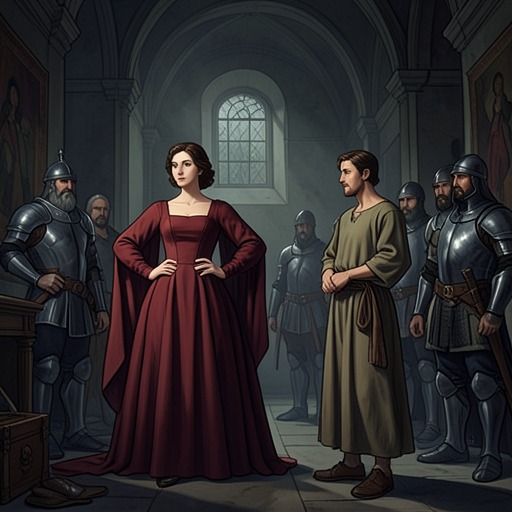
Launcelot travels to find her after hearing of Arthur’s death and other losses. He rides alone, goes westward, and searches for seven or eight days before reaching the nunnery. Guinevere sees him walking in the cloister and swoons repeatedly. When she can speak, she tells the assembled ladies that their love brought about the war and the deaths of the noblest knights, including Arthur. She asks Launcelot never to see her again, to return to his own realm, and to keep it from further war. She also urges him to pray for her and to amend her own former life through repentance.
Launcelot refuses the suggestion that he return to worldly life and marry another woman. He says he will follow the same religious course as Guinevere and keep his promise to her, while praying for her. Their meeting therefore ends not in renewed companionship but in a separation that both understand as part of their attempt to turn from their former relationship. Almesbury marks the boundary between their shared past and the penitential lives they undertake afterward.
Death and the Journey to Glastonbury
The narrative later returns to Almesbury through a vision that comes to Launcelot three times in one night. It directs him, in remission of his sins, to go there and bring Guinevere’s body to be buried beside her husband, King Arthur. Launcelot takes the vision to the hermit, who advises him not to disobey it. With seven companions, he sets out on foot from Glastonbury; weak and feeble, they cover the little more than thirty miles in two days.
When Launcelot reaches the nunnery, Guinevere has died only half an hour earlier. The ladies tell him that before her death she had said he had become a priest and was hurrying to fetch her body. They also report that she had prayed throughout her final two days never again to see him with her worldly eyes. He sees her face but does not weep greatly; his response is marked instead by a sigh and by the funeral duties he undertakes.
Launcelot conducts the service himself, including the Dirige, and sings mass the following morning. The queen’s body is carried on a horse bier, surrounded by one hundred burning torches, while Launcelot and his companions walk beside it, reading prayers and attending the procession with incense. At Glastonbury, the burial service continues at the chapel and hermitage. The body is wrapped in thirty folds of waxed cloth, placed in lead, and then laid in a marble coffin before being buried.
Meaning in the Ending
Almesbury is one of the three places through which the final movement of the story is organized: Arthur is borne away in a barge toward the Holy Isle, Guinevere lives and dies as a nun at Almesbury, and Launcelot with his companions becomes a community of hermit-priests. The place gives the queen’s withdrawal a concrete setting and brings the consequences of the lovers’ history into the same religious frame as Launcelot’s penance.
The burial journey from Almesbury to Glastonbury joins private grief to the public memory of the fallen king and queen. In the account of Launcelot’s mourning, he explains that his sorrow concerns not a return to sinful love but the memory of Guinevere’s nobility, the couple’s goodness toward him, and his own pride and failure, which he believes helped bring them low. Almesbury thus stands at the threshold between Guinevere’s secluded end and the final act of remembrance that places her beside Arthur.